Maintenance of Commercial Kitchen Equipment: Long-Lasting and Efficient Use
What should you pay attention to in order to extend the life of commercial kitchen equipment? Maintenance tips for ovens, refrigerators, dishwashers and ventilation systems.
5 min read İstanbul Profesyonel
Maintenance of Commercial Kitchen Equipment: Long-Lasting and Efficient Use
In a professional kitchen, equipment running smoothly is very important for the continuity of daily operations. An oven that breaks down during busy service hours, a refrigerator that does not cool sufficiently or a dishwasher that stops working can affect the entire order of the kitchen.
Moreover, such problems do not always appear suddenly. Small changes in performance, unusual noises or maintenance that is not carried out regularly can often be early signs of bigger breakdowns.
For this reason, maintenance of commercial kitchen equipment should not be seen as something done only when an appliance breaks down.
Why Is Maintenance Important for Commercial Kitchen Equipment?
Equipment used in restaurants, hotels, cafes and institutional meal production facilities is exposed to much more intensive working conditions than household appliances.
Cooking equipment running all day, refrigerators that are constantly opened and closed and dishwashers washing load after load naturally wear over time.
Regular maintenance helps monitor the effects of this wear and notice possible problems early.
In addition, clean and correctly adjusted equipment can help keep energy consumption under control and maintain production quality.
What Is Periodic Maintenance?
Periodic maintenance is checking and cleaning equipment at regular intervals in line with the manufacturer's instructions and carrying out the necessary service work.
The goal here is to assess the appliance's operating condition regularly instead of waiting for it to break down.
Maintenance frequency is not the same for every piece of equipment. Usage intensity, the appliance's model, the working environment and the manufacturer's recommendations should be taken into account.
For example, the maintenance needs of a busy restaurant's dishwasher may differ from those of an appliance used only at certain hours.
Maintenance of Commercial Ovens and Ranges
Ovens, ranges, griddles and fryers are among the most heavily used equipment in professional kitchens.
Grease and food residue that build up on these appliances can over time cause cleaning problems, loss of performance and, in some cases, an increased fire risk.
For this reason, cooking surfaces, removable parts and accessible areas should be cleaned regularly in line with the manufacturer's cleaning instructions.
In combi ovens, depending on the appliance's features, topics such as automatic washing programs, scale management and water quality also become important.
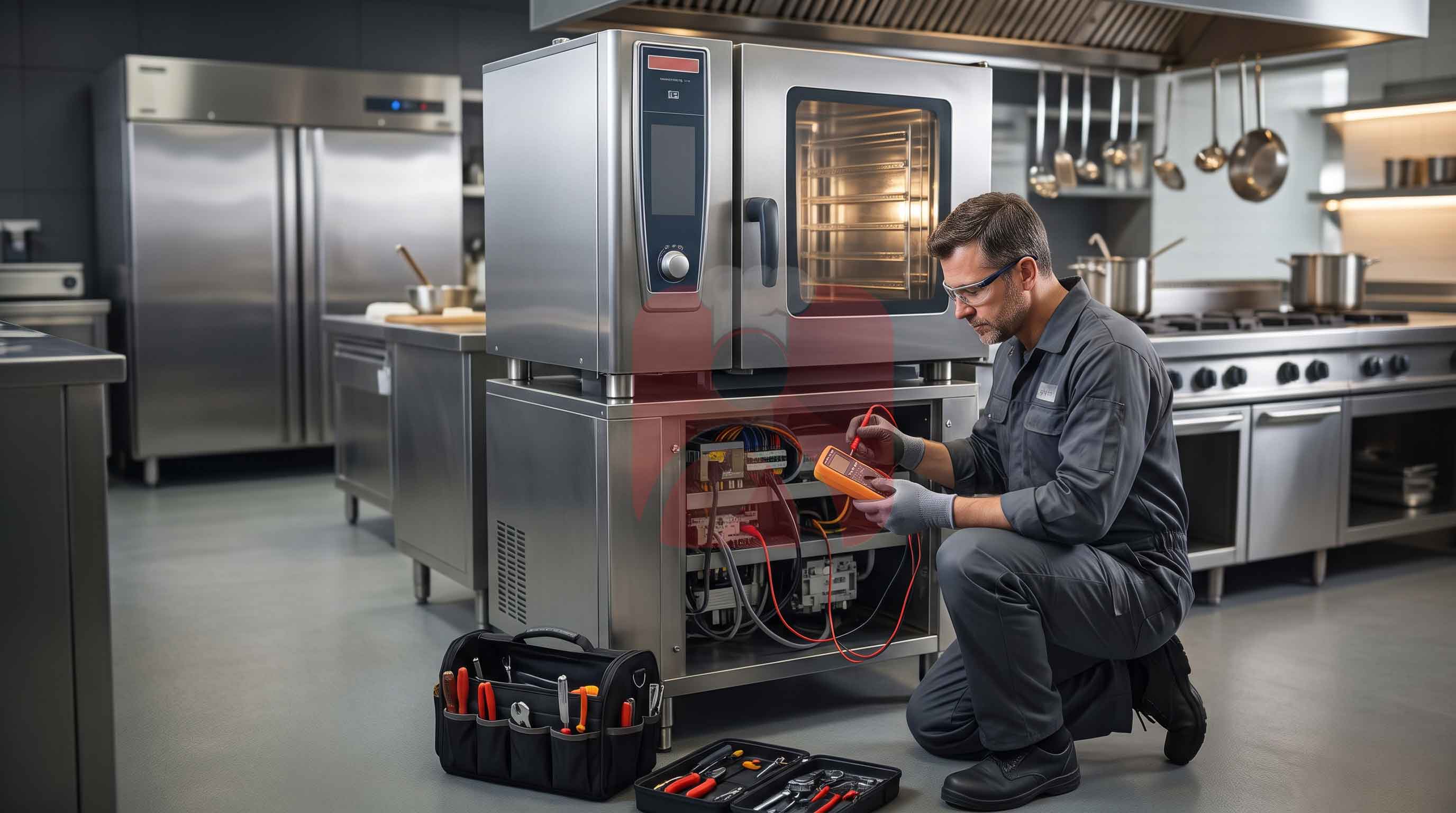
Work related to gas connections, electrical components and the appliance's internal mechanisms should be carried out by authorized technical personnel.
Commercial Refrigerators and Refrigeration Systems
Refrigeration equipment is one of the most critical parts of the kitchen in terms of food safety.
A refrigerator appearing to work does not necessarily mean it is keeping products at the right temperature.
For this reason, temperature readings need to be monitored regularly and unexpected changes need to be taken seriously.
Intact door gaskets, unobstructed air circulation and not loading the appliance beyond its capacity also affect refrigeration performance.
On some models, tasks such as condenser cleaning are part of periodic maintenance. However, these tasks should be carried out according to the appliance's design and the manufacturer's instructions.
It is especially important to get technical support when temperature fluctuations, excessive icing or unusual operating noises are noticed.
Maintenance of Professional Dishwashers
Due to intensive use, commercial dishwashers are appliances that require regular cleaning and maintenance.
Food residue building up in the filters, clogged wash arms or incorrect chemical dosing can adversely affect washing performance.
Cleaning the filters and accessible parts after daily use in line with the manufacturer's instructions helps the appliance work efficiently.
Water hardness is also an important factor. Scale buildup can affect the performance of heating and water circulation systems in particular.
For this reason, suitable water treatment or softening solutions should be evaluated according to the requirements of the machine used.
Maintenance of Hoods and Ventilation Systems
In professional kitchens, ventilation systems are not used only to control the ambient temperature.
They also play an important role in removing the steam, smoke and grease-laden air produced during cooking.
Grease that builds up in hood filters and exhaust ducts in particular can create serious fire risks over time.
For this reason, filters need to be cleaned regularly, duct systems need to be checked at appropriate intervals and the necessary professional cleaning work needs to be carried out.
Cleaning and maintenance intervals should be determined according to cooking intensity, the equipment used and applicable fire safety requirements.
How Can You Tell When Equipment Needs Maintenance?
Some breakdowns appear clearly, while others show themselves through small changes.
For example, an oven heating up more slowly than usual, a refrigerator not reaching the desired temperature or a dishwasher's wash quality declining are situations that need to be investigated.
Likewise, unusual noises, water leaks, error codes and unexpected increases in energy consumption should also be taken into account.
Each of these signs does not necessarily mean a major breakdown. However, ignoring them can lead to more costly problems.
Especially in situations such as a smell of gas, signs of electrical burning or a serious water leak, the appliance should be taken out of use and authorized support should be obtained by following the appropriate safety procedures.
Are Daily Cleaning and Technical Maintenance the Same Thing?
Two topics that are often confused in professional kitchens are daily cleaning and technical maintenance.
Daily cleaning covers cleaning equipment surfaces, filters and parts that come into contact with food using appropriate methods.
Technical maintenance, on the other hand, may involve checking the appliance's mechanical, electrical and other technical components.
Both practices are important, but one does not replace the other.
Employees need to know their daily cleaning responsibilities, while technical work needs to be carried out by people with the appropriate competence.
What Does a Maintenance Plan Bring to a Business?
A business may have dozens of different pieces of equipment. Leaving the maintenance needs of each appliance to employees' memory alone can lead to lapses over time.
Creating a simple maintenance plan makes this process easier.
Recording the brands and models of equipment, maintenance dates, work carried out and problems encountered allows the business to track the history of its appliances.
These records help identify recurring breakdowns and plan future maintenance needs more accurately.
The purpose of a maintenance plan is not to create unnecessary work, but to keep the kitchen's daily operations running as uninterrupted as possible.
Conclusion: Equipment Maintenance Is Not an Expense, but Part of Business Continuity
Commercial kitchen equipment is an important investment for professional businesses.
Whether these investments can be used efficiently for many years depends not only on choosing the right equipment but also on proper use and regular maintenance.
Noticing small problems early, keeping up with cleaning practices and carrying out technical maintenance on time can help reduce unexpected downtime.
As İstanbul Profesyonel, with our commercial kitchen equipment and design solutions, we contribute to creating durable, functional kitchens suited to the needs of businesses.
Because what matters in a professional kitchen is not only that equipment works well on the first day, but that it can be used reliably for years.
Last updated